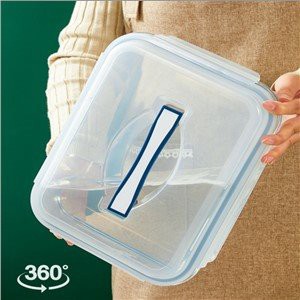
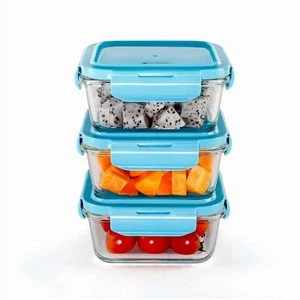
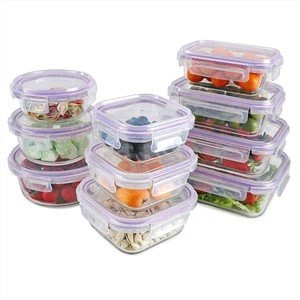
What is Borosilicate Glass Food Container


Unlike plastic, certain glass containers can go from freezer to microwave or oven to table. They're made of a nonporous surface, so they don't absorb smells or stains like plastic containers.


Benefits of Borosilicate Glass Food Container


Glass Containers are Easy to Clean
Glass has a non-porous surface, which makes it easier to clean. Because it doesn' t have pores like plastic, food particles can' t get stuck in them and grow bacteria. Glass doesn' t deteriorate over time and can survive hundreds of cleanings in the dishwasher.


Glass Can Be Put in the Freezer
Freezing temperatures do not damage glass the way they do plastic which makes them ideal to use to store frozen food. While glass can handle freezing temperatures and being heated, it' s not a great conductor of heat. If you put hot glass into cold water, or vice versa, the surface contracts and causes the glass to break so it' s important to heat or cool glass slowly if it' s been exposed to an extreme temperature. When moving food from the freezer to be cooked or storing leftovers I recommend leaving the container on the counter for a short time to cool down or heat up before doing so.


Glass Containers are Safe for Heating
Despite not being a great conductor for heat, glass is generally safe to put in the oven and microwave. Most makers of glass food containers such as Pyrex mark their products safe for use in the oven which means the glass can withstand the heat and doesn' t have any coatings that would make it unsafe.


Glass Food Containers Are Toxin Free
Glass containers won' t add to your body' s toxic burden. Glass containers are toxic-free and don' t contain phthalates or BPA so nothing is leaching out of glass into your food.

First 1234 Last 1/4
 
Why Choose Us
 
01/

Professional team
We have a team of skilled and experienced professionals who are well-versed in the latest technology and industry standards. Our team is dedicated to ensuring that our customers get the best service and support possible.

02/

Competitive prices
We offer our products at competitive prices, making them affordable for our customers. We believe that high-quality products should not come at a premium, and we strive to make our products accessible to all.

03/

Rich experience
Has a long-standing reputation in the industry, which makes it stand out from its competitors. With over many years of experience, they have developed the skills necessary to meet their clients' needs.

04/

Efficient and convenient
The company has established marketing networks around the world to provide high-quality services to customers in an efficient and convenient manner.

05/

Quality assurance
In terms of quality assurance, the company strictly follows the standards and norms of the industry quality system. Adopt industry-leading testing equipment to ensure product quality and good reputation.

06/

Professional service
We can accept factory inspection and goods inspection at any time. Technical discussion, research and development of new products, and complete after-sales service.


18 PCS Food Containers Set


Are Glass Containers Safe for Storing Food in the Refrigerator

Temperature Considerations
When it comes to food storage, borosilicate glass is the ideal choice. This glass can withstand temperatures as low as -20 degrees Celsius, making it perfect for storing food in the fridge. It also has a low rate of thermal expansion, meaning it won' t crack or shatter when exposed to sudden temperature changes. That' s why glass containers made from borosilicate glass, like Allo glass containers, are considered safe for storing food in the fridge.


Choose the Right Size Container
When it comes to storing food in the fridge, it' s important to choose the right size container. Glass containers come in a variety of sizes, so it' s easy to find one that fits your needs. Whether you' re storing leftovers, preparing meals ahead of time, or keeping snacks fresh, there' s a glass container for the job.


Perfect and stylish
Glass food storage containers are also great for keeping food fresh. The tight-fitting lids help keep food fresh for longer, and the clear glass lets you see what's inside at a glance. This makes it easy to know what you have on hand and when you need to use it.


Glass Food Container Market Outlook (2024 - 2032)

From 2024 to 2032, the Glass Food Container market displays a consistent and positive growth direction, indicating a favorable outlook for the industry. This growth is propelled by several key factors, including increasing consumer demand, advancements in technology, and shifting consumer preferences.


A significant driver of the Glass Food Container market is the growing consumer awareness of health and wellness. This heightened consciousness has resulted in a surge in demand for Glass Food Container products that are perceived as healthier and more natural alternatives. Furthermore, technological advancements within the Glass Food Container industry have led to the emergence of more efficient and sustainable production methods, further enhancing market growth.


Key players in the industry are making substantial investments, which are anticipated to drive innovation and fuel market expansion. These investments primarily focus on the development of new products and the expansion of distribution networks, which in turn will stimulate future demand.


The outlook for the Glass Food Container market is optimistic, with sustained growth expected in the coming years. Increasing consumer demand, advancements in technology, and investments from key industry players are poised to drive growth and advance innovation within the market.

18 PCS Food Containers Set
Glass Food Container Specifications to Check
 

Capacity

The primary objective of the glass container would be to have a good volume. This will ensure that it can hold the desired quantity of what you intend to store in the container. More capacity helps store more quantity.

Shape

The shape of the container also plays a role in storage. However, the shape depends on the intended use of the container and the type of food item you are going to store in it.

Heat Resistance

It is better to get a heat-resistant container so that you can store hot food and liquids without it breaking. Additionally, these types of containers will also be microwave and oven-friendly for you to easily reheat or cook food.

Weight

Lighter options are safer if you are planning on using it frequently. The weight of the glass container also determines its portability. If it is heavier, it may not be a wise idea to carry it around.

Cold Resistance

This is important if you're going to store the food in a glass container in a fridge. Getting a container which is not cold-resistant will lead to it cracking due to thermal shock.

Grip

Since the glass surface is smoother, it may result in it falling easily. To avoid this, it is safer to have grip indentations or handles to ensure secure handling without losing grip.


Manufacturing Glass Food Containers


Glass containers remain in widespread use across the world and are used for countless different functions, whether it is jars for jam or bottles for beer. The popularity remains because they are much better at preserving the taste of their contents. Although plastic containers are cheaper to produce, they allow flavours to diminish at a much faster rate. Glass containers will also last much longer when you reuse them because they are easier to clean and won' t deteriorate anywhere near as quickly. Additionally they are better for the environment because the material is more widely recycled.


Manufacturing glass containers is more costly than plastic because it is a more sophisticated process and takes longer. Products are typically made using an advanced moulding process that allows batches to be made at one time. Usually bottles are manufactured using a set of moulds that ranges in size from six to forty. Regardless of the number it is essential that every mould is the right dimensions. The surfaces also need to be incredibly smooth so that finished containers don' t have rough or jagged finishes.


The hardest part of a glass container to manufacture is the neck and closure. This section needs to be very strong because it will be put under pressure when people screw on and unscrew lids as well as when items are stacked. The closure also needs to be perfectly smooth so that a proper seal will be created when a lid is put on.


A glass container is made using two different moulds. The blank mould makes the neck, enclosure and part of the body called a parison. A blow mould is then used to form the parison into the final shape. Both need to be absolutely perfect if you want the finished product to be the right dimensions and have the required strength and finish.


Checking the size of moulds is very important and you' ll need the right tools to accomplish it. Blow and blank mould gauges are essential to make sure sizes are accurate. If you want to be successful and produce quality glass containers having the right gauges and checking moulds regularly is critical.


Why Glass Food Containers Are Better Than Plastic Containers
High Borosilicate Heat-resistant Glass Food Container
Oven Lunch Box
Square Glass Food Container with PP Lid
Rectangular Glass Food Container with PP Lid

Glass is Free from Toxins
The most important reason to pick glass containers over plastic ones is their toxic-free property, which means it doesn' t give exposure to toxins for your body. On the other hand, many of the plastic containers have the presence of BPA, a harmful chemical which can transport into your body if you eat the food stored in them. As per Mayoclinic, plastics marked with recycle code 3 or 7 may contain BPA, so highly avoid them. It also trespasses the flavour which makes the food taste different than what it actually is.


Glass Can be Recycled
Glass is truly 100% recyclable over and over again without any loss in quality and property. Although a high amount of energy is needed for its recycling, it can be transformed into a new product over and over again infinitely. In the case of Plastic, it loses its quality each time it gets recycled that' s why it needs to be turned into something else each time it is recycled. It is also not possible every time to recycle plastic.


Glass is Safe for Heating
Re-heating the leftover or the lunch packed in tiffin is a day-to-day task. Thankfully, when it comes to glass containers heating is not an issue, unlike plastic ones. Glass is generally safe for cooking, storing, and microwaving food and keeps the food fresh by retaining the nutrient-quotient because they don' t leach chemicals while heating.
Meanwhile, plastic containers even termed as “microwave-safe” might not melt when kept in the oven however it does transfer chemicals to your food. As per an article of Harvard Health Publishing, plastic consists of certain chemicals that can cause health problems like metabolic disorders, and reduced fertility.


Glass Looks Appealing
If you are an organizer fanatic, glass containers should be in your grocery list the next time. It looks beautiful and aesthetically pleasing too. They also take up less space in the fridge, pantry, and cabinets due to their varied shape and sizes. Mason jars, containers, utensils, or crockery are some of the many glass products that look gorgeous and give a luxurious look to any of your storage areas.


Glass Can be Used for Longer Periods
Investing in glass jars and containers is a great deal because they can be used for a longer period. Sure they need more care because they are more prone to breakage. Some precautionary measures like being careful while handling glass containers as they are fragile should be taken into account while handling glass containers and you' re good to go. However, they remain the same throughout no matter how much you put them to use.
While plastic loses the colour due to excess usage and heat content, this doesn' t make them a good idea to use in the long run.


Glass Can' t be Stained
Glass containers don' t store oils or spices due to their nonporous surface. As a result, it doesn' t stain or grow bacteria and can be cleaned easily too. While certain food items get trapped in the pores of plastic and get stained so easily. Excessive usage of microwave safe plastic containers makes it prone for sauces to get trapped because the size of pores kept on increasing due to heat. The colour of the containers also fades off which doesn' t make them look good.


Glass Can be Put in Freezer
You should always freeze your food in glass because glass can handle the freezing temperature. On the other hand, plastics can deteriorate due to freezing temperatures and BPA will enter your body as you eat the food. Just be careful while putting glass in freezers, cool glass slowly if it' s been exposed to hot food or beverages before keeping it inside else it might cause the glass to break.


What to Look for When Buying Glass Food Storage Containers


Lid Material
When choosing the right glass food storage container, you’ll want to make sure you pay attention to the lid. You’ll come across plastic, metal, wood, and glass lids and each has its pros and cons. If you want to be able to heat up a container in a microwave, make sure the lids are compatible. As Spicer noted, glass containers keep out unwanted pests, this is also the case for the lid material. While the lid may add to a container's aesthetic, if there’s even a possibility for pests, you'll want to go with an airtight option.


Set Variety
Having a variety of glass food storage can make all the difference for space and organization. So you’ll want to choose sets with different sizes for easier maintenance and different needs. "Decanting dry goods to airtight glass containers [can] help us easily see when supplies are running low, use the space more efficiently, and it motivates us to stay organized," says Ter Avest. So incorporating set variety in your home helps keep your life on track.


Features
When you’re narrowing down choices, think about some of its features. Do you need tempered or borosilicate glass? Is leakproof necessary? What about an oven-safe, microwave-safe, and freezer-safe container? Depending on your needs you’ll find that one that works better than the others. Just remember that if the goal is to store your food safely in the freezer, then tempered or borosilicate glass is the answer.


Maintenance
All glass food containers should have some ease when you’re cleaning them and using them for your food. When debating whether glass food containers are great for storage and reheating, "Storage glass casseroles or glass bowls are great for storing leftovers in the fridge as they can just easily be transferred into the microwave to heat up," says Charif. "Glass also manages to deal with heat much better than plastic, making it perfect to heat up and eat out of." The nonporous nature of glass just makes your life easier for cooking and longevity.


Our Factory
 

Shandong Lehe Housewares Co., Ltd, covers an area of 15000.00 square meters, established in 2014 with more than 800 employees. We devote ourselves to the research and production of borosilicate glassware and other glass products. Now we are the biggest manufacturer of high borosilicate glassware in ASIA. Lehe has always committed to researching and developing safe and healthy glassware for the people all over the world. Our popular products are heat-resistant glass food container, glass baking trays, heat-resistant glass pot, glass casserole, glass microwave turntable plate. All of products can pass the FDA, LFGB and DGCCRF certificate test. Supported by the advanced technology, our glassware have been exported to Europe, South America, Africa, Southeast Asia and the Middle-east. We also import the raw materials from the United States, Turkey and Russia for many years. Green, environment protection and a healthy life of human beings has always been the direction of our development.We obtained the certification of environment (ISO14001) and quality (ISO9001) management system. We enjoy the right to manage our own imports and exports. Hope to establish the long-term business relationship with you. 


productcate-1-1

Certifications


productcate-1-1


FAQ

Q: What is a glass container?

A: Glass Container means a container which is designed and intended to hold a beverage, food, cleaning, health, beauty or similar product and is manufactured from a mixture of silicates, borates or phosphates.

Q: Why use glass food containers?

A: Glass has a non-porous surface that doesn't absorb like plastic and can be safely washed at higher temperatures in your dishwasher without melting or warping—most food storage containers made of glass are designed to withstand high heat without breaking.

Q: What type of glass is used for food containers?

A: It is made up of silica and various oxides, including sodium, calcium, aluminum, magnesium, and potassium. Type III is the most common glass type in use and is compatible with most items such as: food, beverages, and common chemicals - and, it is food-grade safe.

Q: What is glass in food packaging?

A: Why glass is an attractive choice: Glass is an inert material that prevents any migration between the packaging and its contents. It is therefore a very attractive food safety material. The transparency and brilliance of glass enhance the product contained. In addition, glass can be recycled over and over again.

Q: How are glass food containers made?

A: Creating glass containers can be accomplished by one of two different processes – the Blow and Blow, or the Press and Blow process. Each process is chosen based on the kind of glass bottle being made. All glass bottles start out as raw materials.

Q: Are glass food containers safe?

A: Glass is non-porous and doesn't release any harmful chemicals into your food. So, by switching to glass, you are adding a layer of safety to your and your family's meals and not worrying about potential health hazards associated with plastic containers.

Q: Do glass containers keep food warm?

A: And you can rest assured that the borosilicate glass holds up to heat and cold wonderfully. These multipurpose containers will upgrade your kitchen and pantry organization.

Q: Which glass is best for food?

A: Borosilicate glass is known for resisting temperature changes that would shatter other types of glass.

Q: What are the advantages of glass food containers?

A: Why choose glass packaging? The benefits of glass packaging are clear: it's sustainable, being 100% and infinitely recyclable, reusable, and refillable. It's inert, with no synthetic chemicals, making it safe to store food and drinks in.

Q: Why are glass containers better?

A: Glass containers have some definite advantages over plastic: They're nonporous and nontoxic, and therefore can't leach harmful chemicals into your food. They're 100 percent recyclable, and more environmentally friendly. They last longer.

Q: How long do glass food containers last?

A: If you're in the market for reusable food storage containers that are strong enough to last a lifetime, then glass, ceramic, and stainless steel are the way to go. “Glass is the most durable and has the greatest longevity, and it's 100% recyclable.

Q: Are glass containers healthy?

A: Plastic containers have the potential to leach chemicals into food. This concern becomes more pronounced when these containers are used to store acidic or fatty foods. In contrast, glass does not leach chemicals, making it a safer option for food storage.

Q: Do glass containers keep food fresh longer?

A: Glass is a non-porous material, which means that nothing, including bacteria, can get through it. This helps to keep food fresher for longer and, as food particles will not get trapped within the material, your food will taste better!

Q: Should you use glass or plastic food containers?

A: Plastic containers can leach toxic chemicals into your food, especially when heated. These chemicals can disrupt hormones and pose serious health risks. Glass, on the other hand, is non-toxic and does not react with food, making it a safer choice for you and your family.

Q: What foods can be stored in glass containers?

A: Jams, jellies, syrups, soups, juices, and handmade sauces can all be simply sorted and stored in glass jars in your refrigerator. For remainders, ignore plastic storage containers; they are bad. In a clear glass jar, save any leftovers, cover them with a lid, and enjoy it later.

Q: Can you put glass containers in the fridge?

A: But when it comes to storing food in the refrigerator, many people wonder if glass containers are safe to use. The answer is yes, glass containers are safe for storing food in the refrigerator, as long as they are made of high-quality glass that can withstand low temperatures.

Q: Is it safe to reuse glass containers?

A: Glass can be reused for all foods and for all processes, regardless of what food was originally packaged in the glass container. The exception to this rule is that one-trip glass jars should not be used for pressure processing in the home canner.

Q: Which is better, plastic or glass containers?

A: When it comes to durability, longevity, and its ability to be recycled, glass is the winner! Glass containers for food and beverages are 100% recyclable and can be recycled endlessly without loss in quality or purity, whereas most plastic will end up in a landfill.

Q: Do glass containers expire?

A: The glass bottle per se does not have any expiration date… Water in any closed bottle will have some expiration date because at room temperature, there will be a slow increase in the bacteria in the water and that affects the quality.

Q: What is the safety of glass containers?

A: Made from natural ingredients, glass is a virtually inert packaging material. It guarantees a protective layer against external influences, making it a safe material for a circular and health-oriented economy.

As one of the most professional borosilicate glass food container manufacturers and suppliers in China, we're featured by quality products and good service. Please rest assured to buy customized borosilicate glass food container at competitive price from our factory. Contact us for more details.

glass food storage box, four locking tabs leak proof, food box glass