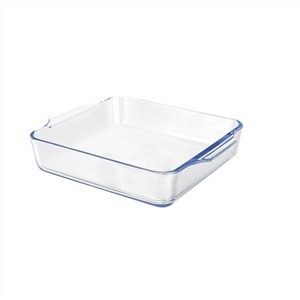
What is Borosilicate Glass Bakeware


Glass bakeware is non-toxic, non-reactive, easy to clean, and can offer superior baking results. If you're looking to replace non-stick bakeware, consider making glass your first choice.


Benefits of Borosilicate Glass Bakeware
 
01/

Good heat preservation and uniform heat transfer
Glass baking trays are made of high-temperature resistant glass material, which can withstand the heat source of high-temperature ovens, have good heat preservation performance, and can evenly transfer heat, so that the color and taste of baked food are better.

02/

Beautiful and easy to clean
Glass baking trays are beautiful and easy to clean due to their smooth surface, which is very helpful for keeping the kitchen clean and hygienic.

03/

Transparent and easy to observe the baking process of food
The transparent nature of the glass baking tray allows users to clearly see the baking process of food, which is especially useful for baking cakes, bread and other foods, and can help avoid over-baking of food.

04/

Prevent food from absorbing unnecessary substances
Glass material can also prevent food from absorbing unnecessary substances, further reducing the difficulty of cleaning, and is also of great benefit to healthy eating.

First 123 Last 1/3
Why Choose Us


Professional team
We have a team of skilled and experienced professionals who are well-versed in the latest technology and industry standards. Our team is dedicated to ensuring that our customers get the best service and support possible.


Competitive prices
We offer our products at competitive prices, making them affordable for our customers. We believe that high-quality products should not come at a premium, and we strive to make our products accessible to all.


Rich experience
Has a long-standing reputation in the industry, which makes it stand out from its competitors. With over many years of experience, they have developed the skills necessary to meet their clients' needs.


Efficient and convenient
The company has established marketing networks around the world to provide high-quality services to customers in an efficient and convenient manner.


Quality assurance
In terms of quality assurance, the company strictly follows the standards and norms of the industry quality system. Adopt industry-leading testing equipment to ensure product quality and good reputation.


Professional service
We can accept factory inspection and goods inspection at any time. Technical discussion, research and development of new products, and complete after-sales service.


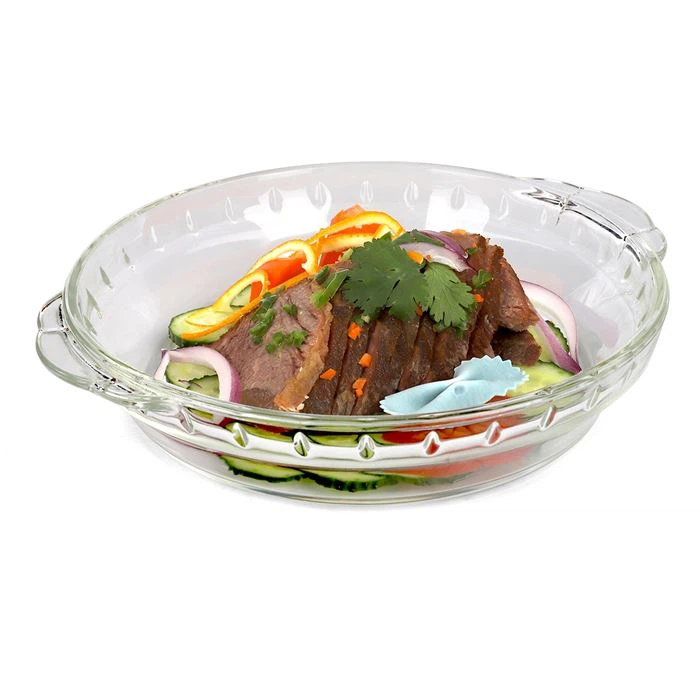
Round Glass Plate High Borosilicate Glass Pizza Plate


Glass Bakeware Market Insights

Glass Bakeware Market size was valued at USD 4.8 Billion in 2023 and is projected to reach USD 7.96 Billion by 2030, growing at a CAGR of 7.9% during the forecasted period 2024 to 2030.


The industry that produces, distributes, and sells bakeware items that are mostly constructed of glass is known as the glass bakeware market. Because of its special qualities and benefits, glass bakingware has become increasingly popular in the home baking and culinary industries. These products include a broad spectrum of kitchen necessities, such as casserole dishes, pie plates, baking dishes, and other glassware that is safe to use in the oven for a variety of baking and cooking purposes.


High-quality, heat-resistant borosilicate or tempered glass is a common feature of professional glass bakeware, guaranteeing stability and safety during baking. The market offers a variety of shapes and sizes to suit a range of recipes and culinary preferences, meeting the needs of a diversified customer base. In this industry, manufacturers frequently prioritize innovation by integrating design components that improve usability, aesthetics, and functionality.


The expanding popularity of baking at home, greater consumer awareness of the health and safety risks connected with alternative materials, and the versatility of glass in terms of its performance at different temperatures are some of the factors driving the market for glass bakeware. Glass bakeware is renowned for its capacity to uniformly distribute heat, withstand stains and smells, and offer a clear view of the cooking process.


Tips and Tricks for Using a Glass Baking Dish
 

Choose the Right Size
The first step in successful baking with a glass dish is selecting the right size. Ensure that your dish matches the recipe's requirements. Using an appropriately sized dish will help distribute heat evenly, resulting in a well-cooked dish.


Preheat Your Oven
Preheating the oven is crucial when baking with a glass dish. It allows for a consistent temperature throughout the baking process, helping your food cook evenly and thoroughly.


Grease or Line
Depending on the recipe, grease the glass dish with butter, oil, or non-stick cooking spray, or line it with parchment paper. This step will prevent sticking and make it easier to remove your baked goods.


Avoid Drastic Temperature Changes
Glass is sensitive to sudden temperature changes. Avoid placing a cold glass dish into a hot oven or placing it on a cold surface when hot. To prevent cracking, let it come to room temperature before baking or use a dish specifically designed for such temperature changes.


Use Oven-Safe Mitts
When removing a hot glass dish from the oven, always use oven-safe mitts or potholders designed to handle high temperatures. This prevents burns and ensures a secure grip.


Adjust Baking Times
Glass dishes tend to retain heat, so you may need to adjust baking times slightly compared to metal pans. Keep an eye on your recipe and make any necessary changes to avoid overcooking.


Reduce Oven Temperature
Glass dishes may require a slightly lower oven temperature than the recipe suggests when compared to metal pans. Reduce the temperature by about 25°F (14°C) and monitor your baking closely.


Allow for Resting Time
After removing your dish from the oven, let it rest for a few minutes on a heat-resistant surface. This allows the temperature to stabilize and your dish to settle.


Avoid Thermal Shock
Glass dishes are sensitive to drastic temperature changes. Never transfer a hot glass dish directly onto a cold surface, as it can shatter. Use a trivet or hot pad to protect your countertops.


Clean with Care
After baking, allow your glass dish to cool before cleaning. Use a soft sponge or cloth to avoid scratching the surface, and avoid abrasive scouring pads. Soak stubborn stains to make cleaning easier.


The Difference Between Glass and Metal Bakeware
3QT High Borosilicate Glass Bakeware
High Borosilicate Heat-resistant Glass Bakeware
Round Glass Plate High Borosilicate Glass Pizza Plate

Material difference
The most obvious difference between glass baking trays and metal baking trays is the material. Glass baking trays are made of tempered glass, while metal baking trays are made of metal materials such as iron and aluminum. The heat conduction and stability of the two are different, so you need to pay attention during use.


Difference in usage
When using a glass baking tray, you need to preheat the oven to a suitable temperature first, then put the ingredients in the baking tray, and bake directly in the oven. When using a metal baking tray, you need to apply oil or oil paper on the baking tray first to prevent the ingredients from sticking to the baking tray. The baking time and temperature also need to be adjusted according to different ingredients.


Difference in baking effect
The heat conduction effect of glass baking trays and metal baking trays is different, so it will have a certain impact on the baking effect. The heat conduction speed of the glass baking tray is slower, and the baked food will be softer and moister, which is suitable for baking vegetables, fish and other ingredients; while the heat conduction speed of the metal baking tray is faster, and the baked food will be crisper, which is suitable for baking cakes, bread and other ingredients.


Differences in cleaning methods
When cleaning a glass baking tray, use warm water and a neutral detergent. Do not use a hard brush or metal tool to scratch it, so as not to damage the surface of the baking tray. Metal baking trays are more durable and can be cleaned with metal tools, but be careful to avoid leaving scratches on the surface.


Differences in safety factors
Because the heat conduction speed of a glass baking tray is slow, it will maintain a lower temperature during the baking process, causing less harm to the human body. Metal baking trays are hotter than glass baking trays, so be careful to prevent scalding during the baking process.


7 Things You Can Do to Prevent Glassware from Shattering


Don' t use glass bakeware on the stovetop or under the broiler, where it will immediately be subjected to high heat.
Preheat the oven before you put your full glass baking dish in the oven. Some ovens will start heating up at a high heat before dropping to the set temp and that could shock the glass.
Defrost dishes and let hot things cool. Don' t put a frozen lasagna directly into a hot oven, without defrosting it. (And don' t put a just-baked one into the freezer.)
If you' re using a glass baking dish to cook something like a chicken or a roast beef, that doesn' t cover the entire surface, add a little liquid to the dish before you place it in the oven to help keep the dish temperature even.
As your chicken roasts, don' t baste it with cold water or broth.
When you take your mac and cheese out of the oven, don' t place it on a cold surface or a wet towel. Make sure you always put the hot dish on a dry cloth potholder.
Try not to drop it or knock glassware around. Even if it doesn' t break, it can develop tiny chips or cracks inside that aren' t visible. 


What Role Does the Shape of the Bakeware Play
 

The shape of your bakeware can make a huge difference in your baking and cooking results. Here' s why

01/

Heat Distribution and Cooking Time
Bakeware shape can influence how evenly heat is distributed. Wide, flat pans like cookie sheets distribute heat well because of their large surface area, perfect for baking cookies or roasting veggies. In contrast, deeper dishes like loaf or casserole pans cook slower and less evenly, which is suitable for recipes like lasagna or meatloaf that need slow cooking.

02/

Food Shape and Presentation
The shape of your dish can determine the form of your food. For example, bread takes the shape of the loaf pan it' s baked in, cookies spread on a flat sheet, and muffins rise in a muffin pan. This can make your food visually appealing.

03/

Recipe-Specific Bakeware
Some recipes need certain bakeware shapes. Pies and tarts require round, shallow dishes with sloping sides for crust support. Bundt cakes need the distinctive ring-shaped Bundt pan to achieve their unique design.

04/

Ease of Use and Safety
The shape of your bakeware can affect its ease of use and safety. Wide pans with handles are easier to grip and remove from the oven. Deep dishes with high sides prevent spillage, making them safer for liquid-filled recipes.


How to Remove Stains from Glass Baking Dish


The Classic Dish Soap and Hot Water Cleaner
The simplest of all methods and yet very effective to get buildup off of a glass or porcelain baking dish is using hot water and dish soap. You might be thinking that dish soap is the magical ingredient here, but you couldn' t be more wrong.
The real work is done by hot water or by soaking the baking dish in hot water, to be more precise. The hot water loosens the greasy buildup and makes it much easier to clean grease off glass baking dish. So if you soak the dish for 15-20 minutes in hot water, you' ll not have to scrub it so much.
As for the dish soap, just add a few squirts, mainly depending on how greasy the dish is. You should add it while the dish is soaking, not just when you start scrubbing.
The trick here is to use hot water because heat makes the grease expand and loosen. Using cold water will not have the same impact.


The Dish Soap, Hot Water & Baking Soda Cleaner
Although the hot water and soap method is simple, some persistent stains just won' t go away so simply. For such stains, a coating of baking soda can be really helpful. Follow the below steps to clean glass casserole dish with difficult stains:
Sprinkle the dish with baking soda: Sprinkle 1sp of baking soda on the dish bottom. Use more if you think the stains are very difficult. Sprinkle more on greasier parts
Pour tiny droplets of dish soap everywhere on the dish
Fill the dish with hot water: If your dish is 2.5cm deep, fill water up to at least 1 cm. If the dish is smaller, you might not need to fill so much water.
Let the dish soak for 15 minutes.
Scrub the dish: After the dish is adequately soaked, pour out the dirty water and scrub with an abrasive sponge. Most of the grease will come off on its own when you throw the water, but some difficult spots will need a little scrubbing.
You will see the dish will have a shine after it' s cleaned. This is primarily because of using baking soda. So, baking soda does two things in one go - loosens the persistent stains and shines the baking dish.


Befriending the Bar Keepers Friend
While baking soda works wonders, it might not be very effective on burnt dishes and more persistent stains. This is when you need something more abrasive, and Bar Keepers Friend is your best friend too.
It is much more effective to clean burnt casserole dish. If you use it once, we are pretty sure you will never have to try another cleaner to clean grease off glass baking dish.
The magical ingredient that makes Bar Keepers Friend much more abrasive than baking soda is oxalic acid.
The cleaning technique is quite similar to the baking soda method, but the cleaning time is much less. Follow the below steps to clean the baking dish using Bar Keepers Friend:
Sprinkle Bar Keepers Friend over the glass baking dish
Start scrubbing the baking dish with a damp sponge
As you scrub, the oxalic acid with cause the water and power to form a paste over the dish. Let the paste settle for around 20 minutes.
Gently scrub off all the grease from the dish and rinse. Your dish will be as good as new.


Clean with what comes naturally to you

While dish soap, baking soda, and Bar Keepers Friend are all very effective, their ingredients are not natural. So, if you prefer more natural ingredients to clean grease off glass baking dish, we suggest using corn starch and vinegar.
Coming straight away to the cleaning steps:

Rinse your dish with some hot water to get it a little wet
Take a separate bowl and mix one teaspoon of corn starch with the same amount of hot water and vinegar.
Corn starch will thicken the mix into a paste, so add a little more liquid to give the paste an easy-to-apply consistency. Remember, always add water and vinegar in equal parts.
Scoop this paste with a scrubber and scrub the dish and witness the magic happening in front of your own two eyes.
It' s always best to use white spirit vinegar for this method. First, it has the strongest acidity. Second, it's colorless, so it won't leave a stain on your glassware. Third, it is odorless, so your dish won't have a repulsive smell when you use it the next time. And fourth, it is easy on the pocket, even with all its magical powers!
While you can clean grease off glass baking dish using many other ingredients such as toothpaste, magic eraser, or dryer sheet, they are either as effective or require more scrubbing. So, it' s best to stick to the basic methods.


Our Factory
 

Shandong Lehe Housewares Co., Ltd, covers an area of 15000.00 square meters, established in 2014 with more than 800 employees. We devote ourselves to the research and production of borosilicate glassware and other glass products. Now we are the biggest manufacturer of high borosilicate glassware in ASIA. Lehe has always committed to researching and developing safe and healthy glassware for the people all over the world. Our popular products are heat-resistant glass food container, glass baking trays, heat-resistant glass pot, glass casserole, glass microwave turntable plate. All of products can pass the FDA, LFGB and DGCCRF certificate test. Supported by the advanced technology, our glassware have been exported to Europe, South America, Africa, Southeast Asia and the Middle-east. We also import the raw materials from the United States, Turkey and Russia for many years. Green, environment protection and a healthy life of human beings has always been the direction of our development.We obtained the certification of environment (ISO14001) and quality (ISO9001) management system. We enjoy the right to manage our own imports and exports. Hope to establish the long-term business relationship with you. 


productcate-1-1


Certifications


productcate-1-1


FAQ

Q: What is a glass baking pan used for?

A: Glass pan: Use a glass dish for baked goods that bake at a low temperature for a long period of time. Examples include quick breads like banana bread or pumpkin bread, fruit or custard pies, topped or filled cakes like coffee cake, and long-baked pasta dishes.

Q: Is glass bakeware good?

A: Glass bakeware, in comparison, is heavier than aluminum and more expensive. Because glass is an insulator, rather than a conductor, it's slow to heat but, once hot, retains that heat for longer. This can result in uneven baking: By the time the interior is baked through, the exterior is often overcooked, dry, or dark.

Q: How to bake with glass bakeware?

A: The standard advice for baking in glass is to lower the oven temperature by 25°F from what the recipe calls for, and bake up to 10 minutes longer. The hard edges we see here are more pronounced in high-sugar, high-fat recipes; your casserole or bread pudding are less likely to be adversely affected.

Q: Does glass bakeware cook faster than metal?

A: Glass bakeware is heavier and slower to heat than metal, but once it's hot, it retains that heat for much longer. So when using a glass pan to bake something like a cake or a batch of brownies, you may find that the sides and bottom will brown at a much faster rate than the interior cooks.

Q: Can you use glass bakeware on stove?

A: Oven-safe glass baking dishes such as Pyrex are not safe to use when broiling. Most of these are not safe to use on the stove.

Q: Can you bake a cake in glass bakeware?

A: Though glass cake pans are fairly common, opting for the material is surprisingly not the best decision. A cake that's baked in a glass pan will be more heavily browned on the outside and, therefore, drier and crustier. In many cases, your cake might be undercooked in the center.

Q: How do you clean glass bakeware?

A: Cornstarch and vinegar work in tandem to remove grease stains from fabric, and it's no different with glass pans. Combine cornstarch, vinegar, and water (1 teaspoon each) in your Pyrex pan and use a mesh scrubber (and some elbow grease) to remove the stains.

Q: What temperature can you bake glass bakeware?

A: Use the dish in pre-heated gas and electric conventional or convection ovens up to 425˚F or microwave ovens without browning element. Not for use on or under a flame or other direct heat source, including on a stovetop, under a broiler, in a toaster oven or on a grill.

Q: When to use a glass baking dish?

A: Can adversely react with acidic ingredients: Some metal pans negatively react with acidic ingredients. So, when making something fruity or citrusy, like a cobbler or a baked lemon pudding situation, you should stick to a glass pan.

Q: What are the benefits of glass bakeware?

A: But when it comes to baking, glass offers a number of benefits over metal pans. Glass bakeware is non-toxic, non-reactive, easy to clean, and can offer superior baking results. If you're looking to replace non-stick bakeware, consider making glass your first choice.

Q: Does glass bakeware cook faster?

A: Glass, as well as ceramic, will conduct heat more slowly than metals like copper or even aluminum. Let's look at metal specifically. Most metal bakeware is made from aluminum. Dark-coated aluminum pans will transfer heat more aggressively than light and shiny aluminum pans.

Q: Can glass bakeware go in the oven?

A: Yes, Pyrex can go in the oven. You can use Pyrex glass cookware to cook, bake, warm or reheat food in pre-heated conventional and convection ovens.

Q: Are glass baking trays safe?

A: Looking for a glass bakeware set that is durable, easy to clean, and safe shouldn't be rocket science, but not all glassware is created equally. Certain glass bakeware can crack or even shatter at moderate to high temperatures, causing burns, cuts, or other serious injuries.

Q: Is glass bakeware non-stick?

A: Save your glass pans for lasagna, plátanos maduros horneados, baked eggs, piñon, casseroles, and doughnut bread pudding—they're easy to clean, they're so smooth they're naturally nonstick, they'll keep your kugel warm as it sits on the table, they won't cause discoloration or off-tastes when you're slow-roasting ...

Q: How to adjust baking time for a glass pan?

A: To try to even out the disparate heat between the edges and center of foods baked in glass, try dropping the oven temperature by 25 degrees and baking longer. A longer bake time might cause the top to brown quicker, in which case you can loosely tent it with foil.

Q: What are the benefits of glass bakeware?

A: Some key advantages of glass cookware is that it responds well for most oven based cooking, it does not react with acidic foods, safely stores all foods in it, and most importantly it is healthy as there are no adverse side effects from cooking in it.

Q: What are the different types of glass bakeware?

A: What are the different types of glass for bakeware? There are three basic types of glassware: soda-lime, tempered, and borosilicate.

Q: What' s the best way to clean glass and metal baking pans?

A: The best way to clean a glass pan is to hand wash it with warm soapy water. Soak the pan first if there is baked-on residue; this will soften and loosen the gunk, allowing you to scrub it off more easily with a sponge. Avoid harsh scouring pads, as they can scratch the surface of the glass.
To wash metal baking pans, soak the pan first in soapy hot water if there are crumbs stuck, but usually, a sponge and hot water will remove most of the residue. Your glass or metal baking pan might also be dishwasher safe, but consult the manufacturer's cleaning and care instructions first before putting it in the dishwasher. And realize that some pans may be listed as dishwasher safe, but harsh dishwashing detergents can corrode or shorten the lifespan of the dish.

As one of the most professional borosilicate glass bakeware manufacturers and suppliers in China, we're featured by quality products and good service. Please rest assured to buy customized borosilicate glass bakeware at competitive price from our factory. Contact us for more details.

square high borosilicate glass bakeware, high borosilicate glass bakeware with handle, pyrex glass baking dish